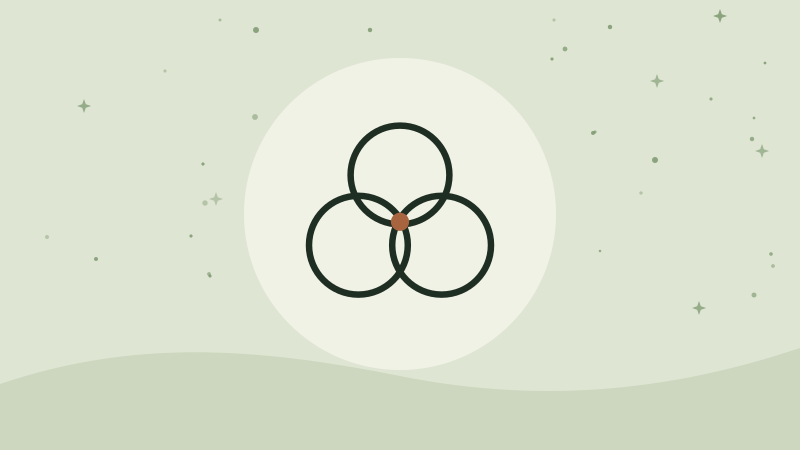
The three words are used so loosely that many newcomers assume they mean the same thing. They do not. Pagan names a family of religions, Wiccan names one religion inside that family, and witch names a practice that anyone can take up.
The short answer
| Word | What it names | Kind of thing |
|---|---|---|
| Pagan | Someone who follows one of the modern nature-revering religions | A broad religious identity |
| Wiccan | Someone who follows Wicca, the religion of the Goddess and the God, the sabbats, and the circle | A specific religion |
| Witch | Someone who practices witchcraft: spellwork, herb craft, divination, and related skills | A practice |
From that table, four statements follow, and they are worth remembering.
- Every Wiccan is a Pagan, because Wicca is a Pagan religion.
- Not every Pagan is Wiccan. Druids, Heathens, and many others are Pagans with religions of their own.
- Most Wiccans are witches, because magick is part of Wiccan practice, although a few prefer not to use the word.
- Not every witch is Wiccan, or even Pagan. Witchcraft is a practice that fits many worldviews.
Four people, four answers
It can help to picture real practitioners.
A Druid who never casts a spell. She keeps the solstices and equinoxes, studies the lore of trees, and writes poetry in honor of the land. She is a Pagan. She is not a witch and not a Wiccan.
A folk witch with no religion. He hangs rowan over the door, makes charm bags, and reads cards for his friends. He does not worship any gods. He is a witch. He is not a Pagan and not a Wiccan.
An initiated coven member. She was initiated into a Gardnerian coven, honors the Goddess and the God, and works magick with her covenmates at every full moon. She is a Wiccan, a witch, and a Pagan, all three.
A solitary who loves the sabbats. He celebrates the eight festivals alone, honors the Goddess and the God in his own way, and follows the Wiccan Rede. He calls himself an eclectic Wiccan. He is a Pagan, and he is a witch if he chooses the word.
Why the words got tangled
When Wicca first became public in the 1950s, its founders did not call it Wicca. They called it witchcraft, or the Craft of the Wise, and they called themselves witches. For several decades the popular books used witch and Wiccan as if they were the same word.
From the 1990s onward, more and more people took up spellwork and folk magick without adopting Wiccan religion, and the two words drifted apart. Today most practitioners keep them separate. It is still common, and perfectly polite, to ask someone what they mean by the word they use.
Which word fits you?
You may find that one fits at once. You may also find that none of them fits yet, which is normal. These questions can help.
- Do you want a religion, with deities, holy days, and shared ritual? Look at Wicca and at the other Pagan paths.
- Do you mainly want to practice, with herbs, candles, cards, and the moon? Witch may be your word.
- Do you feel that nature is sacred but have no interest in spells? You may be a Pagan who is not a witch.
There is no deadline and no test. Many people practice for years before they settle on a word, and some never use one.
A few other words you will hear
The Craft. A common name for witchcraft, and in older books for Wicca.
Warlock. Most male witches simply call themselves witches. Warlock comes from an Old English word for an oath-breaker, and many practitioners dislike it for that reason.
Heathen. In everyday speech it means any non-believer. Among Pagans it means a follower of Heathenry, the Germanic and Norse path.
Neopagan. Another word for a modern Pagan. It is common in academic writing and less common among Pagans themselves.
Solitary. Anyone who practices alone and not in a coven or other group.
You will find more of these in our glossary.