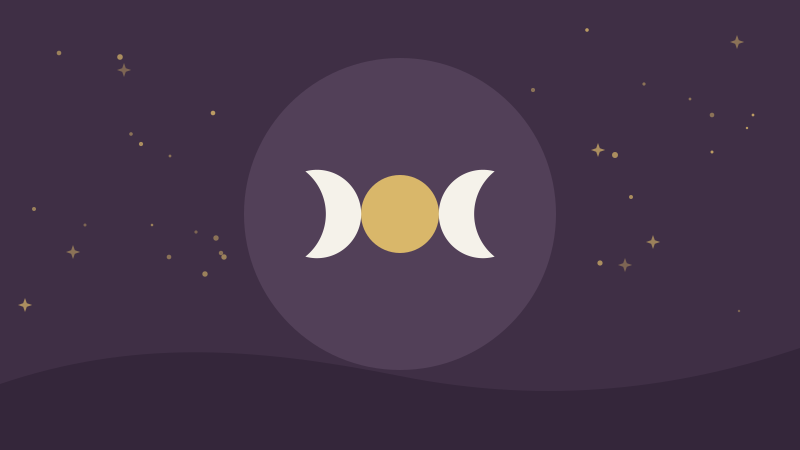
At the heart of Wicca stand two figures: a Goddess, most often linked with the moon, the earth, and the sea, and a God, most often linked with the sun, the forest, and wild animals. Together they express the Wiccan sense that the divine is found within nature and that it is both feminine and masculine.
The Goddess
The Goddess is the constant presence in Wiccan religion. She is the earth that feeds every living thing and the moon that measures time. She is often called simply the Lady.
Her best-known form is the Triple Goddess, who shows three faces that match the phases of the moon.
| Aspect | Moon phase | Themes |
|---|---|---|
| Maiden | Waxing moon | Beginnings, curiosity, independence, and promise |
| Mother | Full moon | Fullness, creativity, nurture, and power at its height |
| Crone | Waning moon | Wisdom, endings, rest, and the mysteries of death and rebirth |
It is worth knowing that the Maiden, Mother, and Crone model in this exact form is a twentieth-century idea, shaped by a poet's reading of myth, although goddesses in groups of three are genuinely ancient. Some practitioners find the model too narrow, since not every life follows those three stages. You are free to use it as a poetic image of the moon and of the stages of any undertaking: beginning, fullness, and release.
The God
The God is the Goddess's partner and, in the yearly story, also her child. His most familiar form is the Horned God, an antlered lord of the woods and of the animals. His imagery draws on figures such as Cernunnos, the antlered god of ancient Gaul, and Pan, the goat-footed god of the Greek countryside. His horns are those of the stag and the goat. They have nothing to do with the devil of Christian tradition.
The God is also the sun, and his life is the story of the year. He is born at the winter solstice, grows through the spring, unites with the Goddess at Beltane, and reaches his height at midsummer. He is cut down with the grain at the harvest, dies at Samhain, and is born again at Yule. Each festival on the Wheel of the Year marks a chapter of that story.
Some traditions tell the story with two figures, the Oak King and the Holly King. The Oak King rules the waxing half of the year, from Yule to midsummer, while the days lengthen. The Holly King rules the waning half, from midsummer back to Yule. At each solstice one gives way to the other.
How Wiccans understand them
There is no official doctrine. These are the most common views, and a single coven may contain all of them.
- Two deities. The Goddess and the God are two real, distinct beings. This view is called duotheism.
- Many names, two faces. Every goddess of every culture is an aspect of the one Goddess, and every god an aspect of the one God.
- Many gods. The gods and goddesses of the world are separate individuals, and the Lady and Lord of Wicca are two among them. This view is called hard polytheism.
- One source. The Goddess and the God are the two poles of a single divine reality that is present in all things.
- Living symbols. They are powerful images of forces within nature and the human mind, and are honored as such.
What matters in practice is relationship. Wiccans speak to the Goddess and the God, give thanks to them, and feel their presence in the turning of the moon and the seasons.
The Charge of the Goddess
The best-loved piece of Wiccan liturgy is the Charge of the Goddess, a speech in which the Goddess addresses her people. The version used most widely was written in the 1950s by Doreen Valiente. It tells those who seek the Goddess to gather at the full moon, promises freedom and joy, and ends with the teaching that what you search for must be found within yourself, or it will not be found at all.
The Charge is often read aloud at full moon rituals. Many solitaries read it slowly as a meditation.
Working with other deities
Many Wiccans and witches build relationships with particular gods and goddesses: Brigid, Hecate, the Morrigan, Freya, Apollo, Isis, and many more. If you feel drawn to one, begin by learning. Read the myths, find out how the deity was honored by the people who first knew them, and proceed with respect and patience. There is no hurry, and nobody is required to have a patron.
Take care with deities and spirits that belong to living, initiatory religions. Their own communities are the right teachers, and an invitation from them is the right way in.
A simple devotion
You do not need a ritual script to begin. Stand at your altar or under the open sky. Light a candle if you wish. Speak aloud, in ordinary words, to the Goddess, the God, or both. Tell them what you are grateful for. Then be quiet for a few minutes and pay attention.
A small offering is traditional: a cup of water, a flower, or a piece of bread, left outside afterward where it will do no harm. Done regularly, this small act is the root from which the rest of a devotional practice grows.
Beyond two
The pairing of a Goddess and a God expresses balance and creative partnership. Many modern Wiccans are careful to add that the divine is not limited to two genders any more than people are. The Goddess and the God can be understood as two points on a circle that includes everything between and beyond them. People of every gender and orientation have a place in the circle.