Symbols are the shorthand of the Craft. They are drawn on altars, worn as jewelry, carved into candles, and traced in the air. This page explains the ones you are most likely to meet, with an honest note on how old each really is.
The pentagram and the pentacle
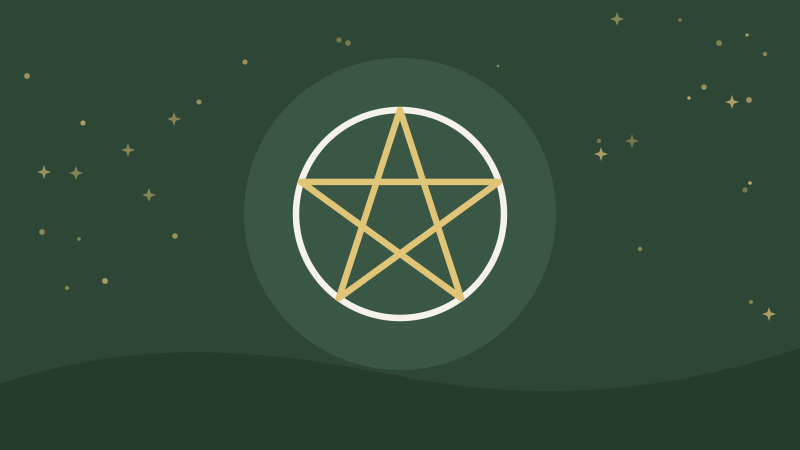
A pentagram is a five-pointed star drawn in one continuous line. A pentacle is a pentagram set within a circle. In Wicca and much modern witchcraft, the five points stand for Earth, Air, Fire, Water, and Spirit, and the circle shows them joined in balance. It is the most widely used symbol of the Craft and a sign of protection.
The five-pointed star is very old. It appears in ancient Mesopotamia and Greece, and in medieval Europe it was used as a protective sign by Christians. Its link with the elements dates from the ceremonial magick of the Renaissance and after. Some traditions use the pentagram with one point down for particular purposes. In popular culture that form became associated with other movements, which is one reason the symbol is often misunderstood.
The triple moon
A full circle with a crescent on either side, one waxing and one waning. It represents the three visible phases of the moon and the Goddess as Maiden, Mother, and Crone. It is a modern symbol, widely used since the later twentieth century, and it is often worn by those who honor the Goddess. See the Goddess and the God.
The Horned God sign
A circle with a crescent resting on top of it, like a pair of horns. It represents the God of Wicca in his aspect as lord of the animals and the wild. It is also a modern symbol and is often paired with the triple moon.
The Wheel of the Year
A circle divided by eight spokes, one for each sabbat. It shows the cycle of the seasons as a whole and is used on altars and calendars. The eightfold wheel dates from the middle of the twentieth century, although wheel and sun-cross designs are prehistoric. See the Wheel of the Year.
The elemental triangles
Four triangles that stand for the four elements. Fire is a triangle pointing up. Water is a triangle pointing down. Air is an upward triangle crossed by a horizontal line. Earth is a downward triangle crossed by a horizontal line. These signs come from European alchemy and have been in use since the medieval period. They are handy for marking candles and jars. See the elements.
The triquetra
Three interlaced arcs that form a three-cornered knot, sometimes with a circle woven through it. It appears in early medieval art in Ireland, Britain, and Scandinavia, in both pre-Christian and Christian settings. Modern Pagans use it for any sacred three: land, sea, and sky, or Maiden, Mother, and Crone, or mind, body, and spirit.
The triskele
Three spirals or three bent legs radiating from a center. The triple spiral is one of the oldest symbols in Europe. It is carved into a stone at a passage tomb in Ireland that is more than five thousand years old. What it meant to its makers is unknown. Today it suggests motion, cycles, and the threefold nature of things, and it is especially loved by Druids and Celtic Pagans.
The spiral
A single line winding out from a center, or in toward it. It is found in the rock art of almost every continent. In the Craft it stands for the journey inward and outward, for growth, and for the turning of the seasons. Walking or drawing a spiral is a simple form of meditation.
The Green Man
A face made of leaves, or with foliage growing from its mouth. Carvings of this kind are found in medieval churches across Europe. The name Green Man was given to them in 1939, and the idea that they represent a surviving Pagan god is a modern one. Whatever the carvers intended, the image has become a beloved symbol of the life of the woods and of the God in his green aspect.
The witch's knot
Four interlaced loops, usually drawn around a central circle, forming a knot with no beginning or end. It is used as a protective charm and a symbol of binding. Knotwork charms of this general kind are old, and this particular design became popular in the twentieth century.
The besom and the cauldron
These are two tools that have become symbols. The besom, or broom, stands for cleansing and for the threshold of the home. The cauldron stands for transformation, plenty, and rebirth, and it has deep roots in Celtic myth, where magical cauldrons restore the dead and never run empty.
The awen
Three rays of light spreading downward from three points, often within circles. It is the chief symbol of modern Druidry. Awen is a Welsh word for poetic inspiration. The sign was devised in the eighteenth century, during the Druid revival.
Thor's hammer
A short-handled hammer, called Mjolnir, worn as a pendant. Small hammer amulets were genuinely worn in the Viking Age, and many have been found by archaeologists. Today the hammer is the most common sign of Heathenry and stands for protection and for loyalty to the old gods.
The ankh
A cross with a loop in place of the upper arm. It is the ancient Egyptian sign for life and appears throughout Egyptian art in the hands of the gods. It is used today by those who follow Kemetic religion, and it is widely worn as a symbol of life.
Wearing and using symbols
- Learn before you wear. Know what a symbol means and where it comes from. Some signs belong to living religions and should be worn with understanding.
- Be aware of context. A few Norse and Germanic symbols have been misused by extremist groups. Our guide to the runes says more.
- Make it yours. A symbol drawn with attention on a scrap of paper is as effective as a silver pendant.
- Discretion is allowed. If you cannot wear a pentacle openly, a plain ring, a small stone, or a knot in a cord can carry the same meaning for you alone.